Projects can reward durable participation—not just a wallet balance. Use the JUP Staker Scanner to identify long-term JUP stakers for community drops, then read JUP staking explained to separate governance mechanics from any campaign eligibility claim.
When a project wants to thank the people who have shown up consistently, a current token balance is a weak starting point. A wallet may have bought yesterday, moved tokens between accounts, or briefly staked and exited. Those wallets can look identical to long-term supporters in a simple snapshot.
The JUP Staker Scanner gives projects a more useful lens: current active stake, a minimum balance, and time spent above that balance. That makes it easier to discover a potential audience for loyalty rewards, early access, or airdrop campaigns without asking users to connect a wallet.
Important: This is an independent StonkBuilders analysis tool. It is not affiliated with or endorsed by Jupiter, and it does not determine eligibility for any Jupiter or third-party airdrop. Its results describe public on-chain activity; only the project running a campaign can define its rules.
Why duration is more useful than a snapshot
“How much do they hold?” is easy to ask and easy to measure. “How long have they stayed committed?” is a better question when the goal is to reward alignment.
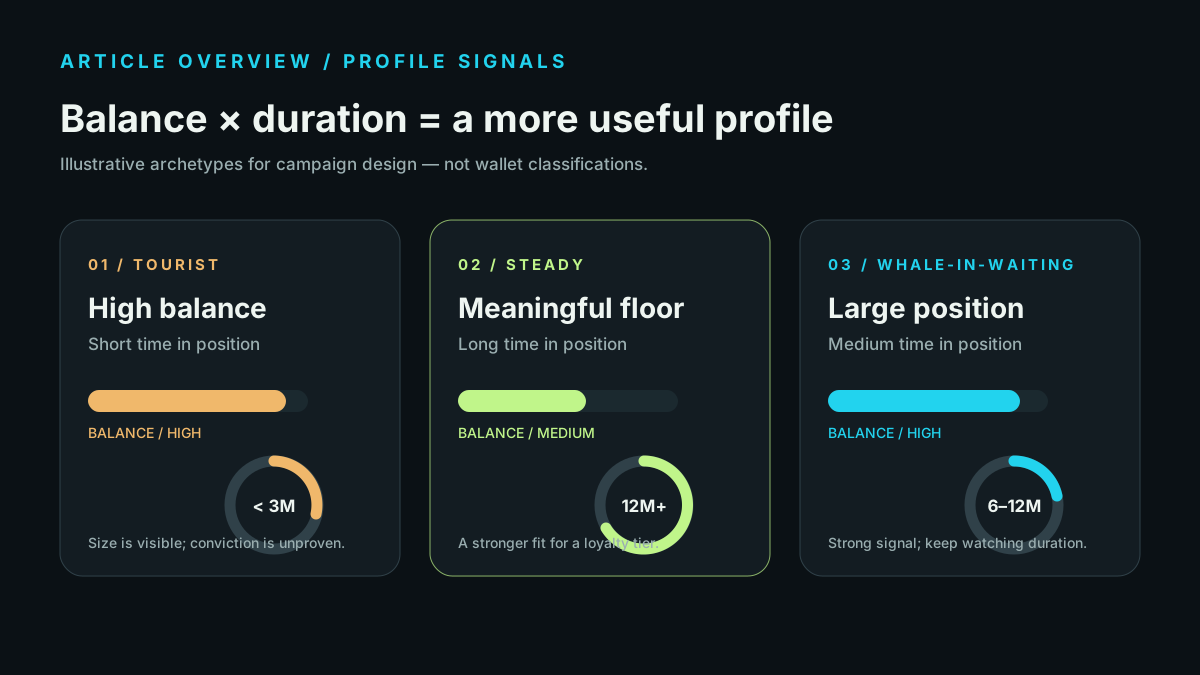
A balance-only list tends to favor the loudest numbers. It can overrepresent recent accumulation, treasury wallets, custodial structures, or accounts that have changed hands. A duration-aware list adds behavior to the picture. It helps a project separate:
- Recent accumulators: wallets with a meaningful balance but little time in position.
- Steady supporters: wallets that stayed above a chosen threshold over a sustained period.
- Large but unproven positions: wallets with size that have not yet demonstrated duration.
- Small or incidental positions: wallets that may be better suited to a broad community reward than a conviction-based tier.
Duration is not proof of identity, intent, or future behavior. It is simply a clearer signal than treating every wallet as a row in a balance spreadsheet.
What the tracker actually measures
The scanner reads Jupiter governance staking data on Solana. For each wallet, it derives the associated Locked Voter escrow and reads the authoritative active stake from that account.
For deeper checks, the scanner replays finalized escrow transactions, including staking, partial-unstake activity, cancellations, and withdrawals. A project can then apply a rule such as:
- at least 100 JUP in active stake for six months;
- at least 500 JUP for nine months; or
- at least 1,000 JUP for 12 months.
The important detail is the floor. The clock starts at the most recent upward crossing of the minimum and resets when active stake drops below it. Adding more JUP while already above the floor does not create a second start date.
Read the graph: balance and commitment are different distributions
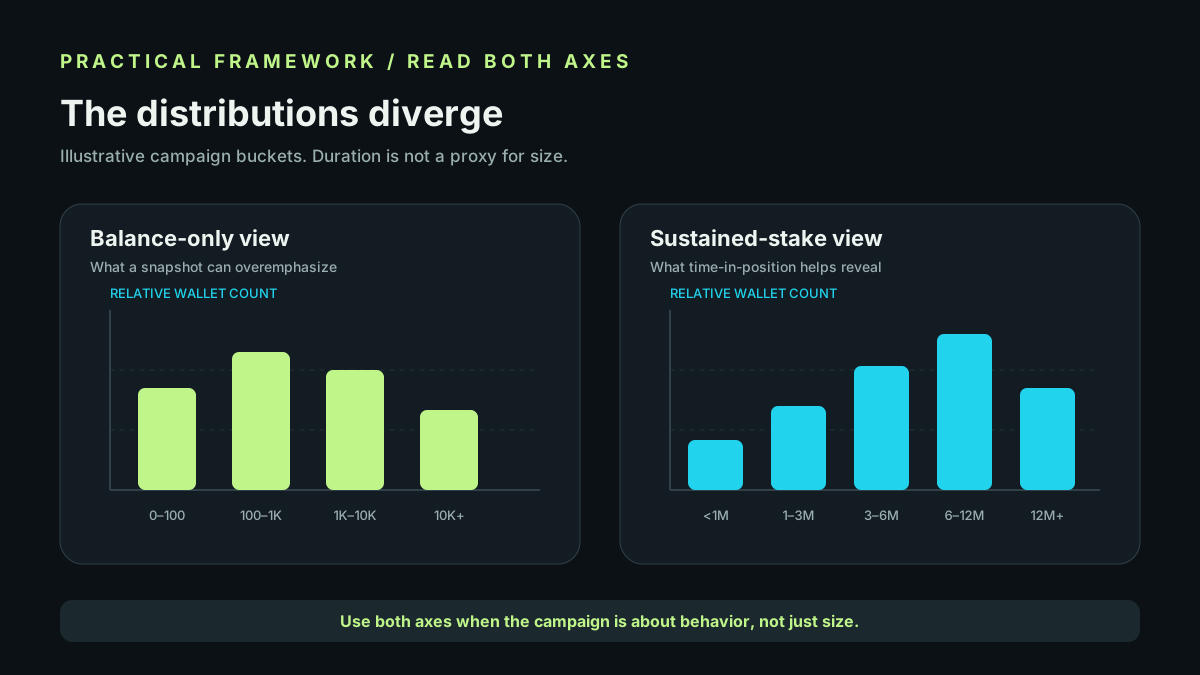
The visual summary above compares two ways to think about the same audience. A balance-only ranking groups wallets by how much they hold today. A sustained-stake view groups them by how long they have remained above a minimum.
Those distributions should not be expected to match. Some large wallets are recent; some moderate wallets are unusually consistent. That divergence is the practical reason to use both dimensions when designing a campaign.
For projects, the right question is not “Who has the most?” It is “Which behavior are we trying to recognize?” A broad acquisition campaign might use current balance. A loyalty campaign may prefer a duration threshold. A two-tier campaign can use both without pretending that either is a perfect measure of community contribution.
A practical workflow for project teams
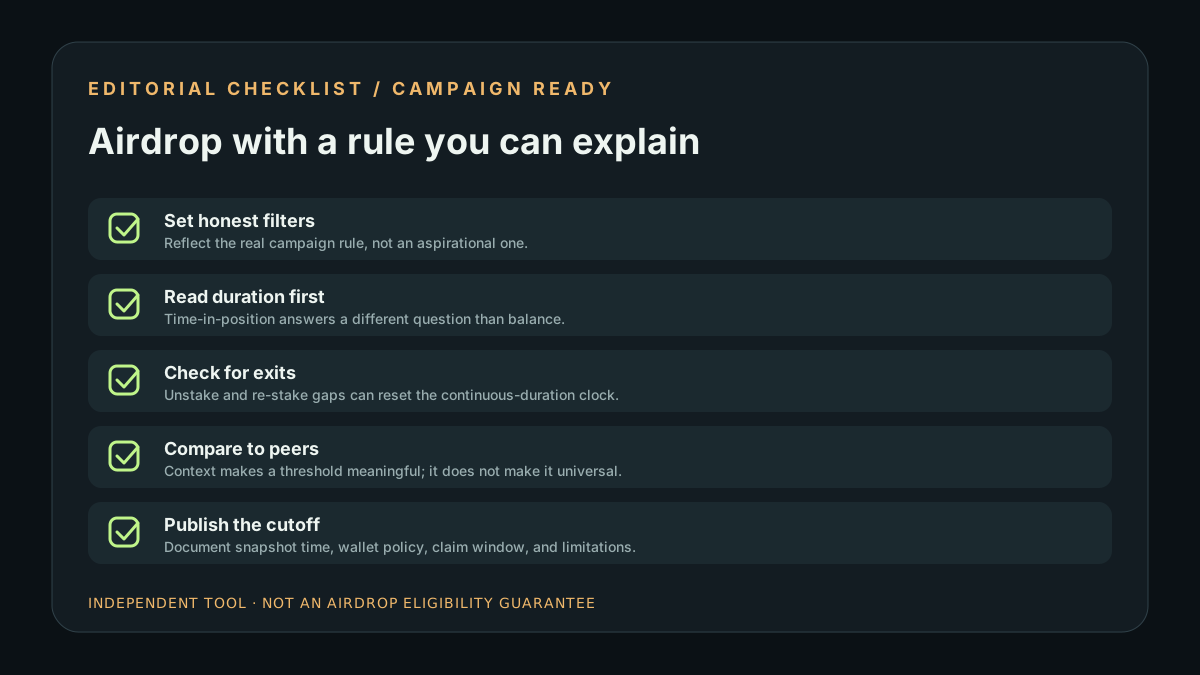
1. Start with a campaign hypothesis
Decide what the reward is meant to recognize before opening the scanner. Is the goal long-term conviction, governance participation, early ecosystem support, or broad awareness? The answer should determine the filter.
2. Set a rule you can explain
Choose a minimum active stake and a duration that match the reward budget. A rule such as “1,000 JUP continuously for 12 months” is easier for a community to understand than a private score with unexplained weights.
3. Discover or audit wallets
Use Discover wallets to explore the broader audience. Use Audit one wallet when a community member asks for a transparent review. Use Screen a list when a project already has candidate wallets from a form, governance forum, or allowlist.
4. Inspect coverage before exporting
The tool reports when historical coverage is still being indexed. Treat an incomplete history as a lower bound, not as proof that a wallet failed the rule. Check the coverage notes before turning results into a final list.
5. Publish the rule and the cutoff
Record the threshold, duration, network, snapshot time, wallet-treatment policy, and claim window. If a project uses multiple tiers, publish the logic for each tier. A reproducible rule is more valuable than a flashy leaderboard.
The crypto analytics guide provides a broader checklist for reading public blockchain reports without confusing an observation with a conclusion.
Design the airdrop around people, not just addresses
An on-chain list is a starting point, not a complete community identity system. A thoughtful campaign should also consider:
- whether one person may control several wallets;
- whether contracts, custodians, or multisigs should be excluded or reviewed separately;
- how Sybil resistance will work without collecting unnecessary personal data;
- whether recipients can claim safely without exposing a seed phrase or private key; and
- how disputes and late claims will be handled.
Do not promise that a wallet is “verified,” “owned by a real person,” or “guaranteed to qualify” merely because it appears in a scan. Say exactly what was measured and what remains unknown.
What this tracker cannot tell you
The scanner cannot know a future distribution’s criteria, and it cannot substitute for official announcements. It also does not automatically measure off-chain activity, referrals, product usage, voting context, or social contribution.
Active stake has a specific meaning here. Opening a partial unstake moves JUP out of active stake immediately; cancelling it moves the tokens back. Tokens in a 30-day full-unstake cooldown still count as active until they are withdrawn, and the tool labels that state. Public RPC limits can also mean that historical replay continues in bounded steps.
That transparency is a feature. Good analytics makes uncertainty visible instead of hiding it behind a score.
The takeaway for builders
Long-term JUP stakers are not automatically better users, contributors, or airdrop recipients. They are an identifiable audience with one observable behavior: sustained participation in Jupiter governance staking.
That signal can help a project make a campaign more intentional, more explainable, and less dependent on arbitrary balance snapshots. Use it alongside your own product criteria, publish the rule, protect recipient privacy, and keep the promise narrow.
Explore the JUP Staker Scanner, browse the StonkBuilders blog, or start with the Learn hub for more evidence-aware guides.
Independent analysis only. Not financial advice, not a Jupiter communication, and not a guarantee of eligibility for any airdrop or reward program.